
← All workCase 01 / 032025
Solis
A pacing app for people with Long COVID. It helps them plan the day around the energy they actually have, so a good day doesn't end in a crash.
- Project
- Mobile app for Long COVID
- Duration
- 6 months
- My role
- Research, UX/UI and interaction design (solo)
- Client
- Miles care watch (Stichting Bestaanskracht)
- Stages
- Empathise, Define, Ideate, Prototype
- Tools
- Figma, HTML prototype
Problem
Energy that changes every day
Long COVID is when the effects of COVID-19 last for months or even years. Fatigue, brain fog, breathlessness and pain are the most common, and more than 200 symptoms have been described. In the UK, four out of five people with Long COVID say it limits their daily life.
Energy changes from day to day, sometimes from hour to hour, and nobody else can see it. On a good day people often do too much and then feel much worse for days afterwards. This is called a crash. The method that helps is pacing, which means staying within your limit even when you feel fine.
Most apps for Long COVID are symptom diaries. They record what already happened, but they don't help with the question of whether to do one more task today.
How can an app support someone whose energy changes from hour to hour, without making their day harder?
My approach
Research first, then one focused tool
Solis started in the Project Design Showcase course at The Hague University of Applied Sciences, with the Miles care watch as the client. I worked on it for six months and did the whole project on my own, from the research to a clickable prototype.
I don't have Long COVID myself, so I began with research. Desk research gave me the medical side, stories on Reddit showed how people cope day to day, and in two interviews people told me about their days in detail.
There are plenty of symptom trackers, but I found almost nothing that helps with pacing. So the main job of Solis became to tell people when to slow down.
Solution
Planning the day around energy
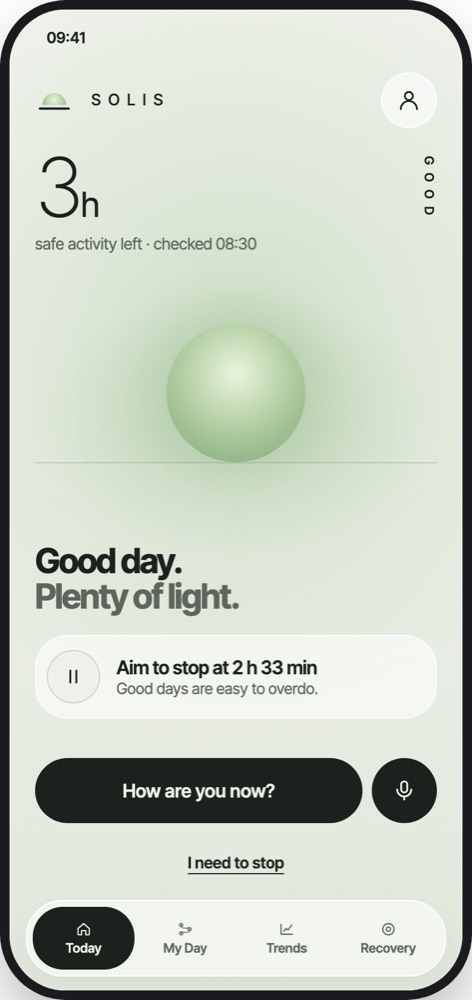
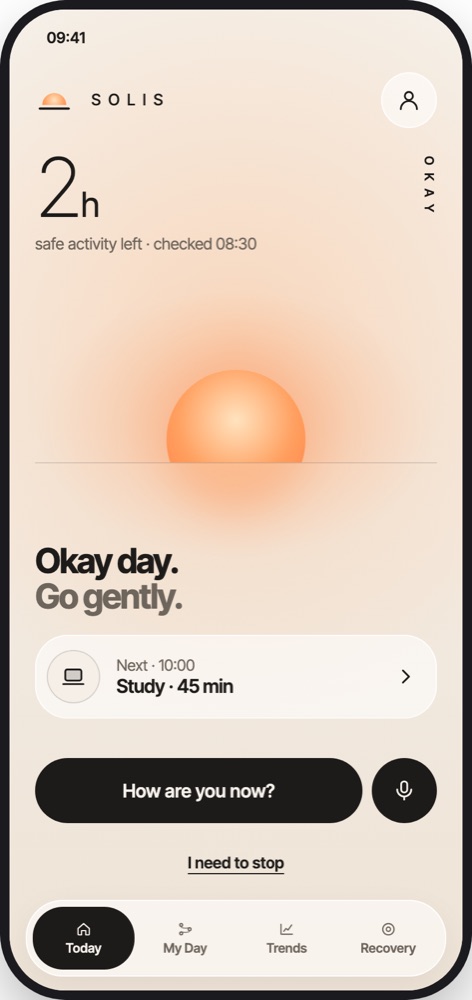
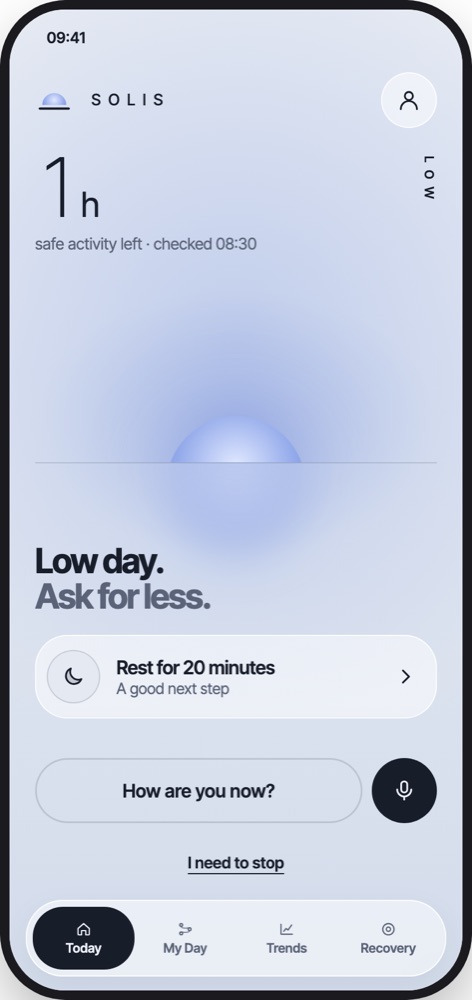
Solis shows how much activity is still safe today. On the home screen the sun stands high on a good day and low on a hard one. The day plan has a limit, so people can see how much they can still do before they risk a crash.
Live Try the prototype
- 01Tap "How are you now?" and pick "Low".
- 02Choose a signal or two, then see the lighter day Solis suggests.
- 03Open "My Day" to see the plan next to today's limit.
- 04Go back to "Today" and tap "I need to stop".
Flow
Three main flows
The three flows people use most: setting up the app, an everyday check-in and a bad day.
Features
What it does
-
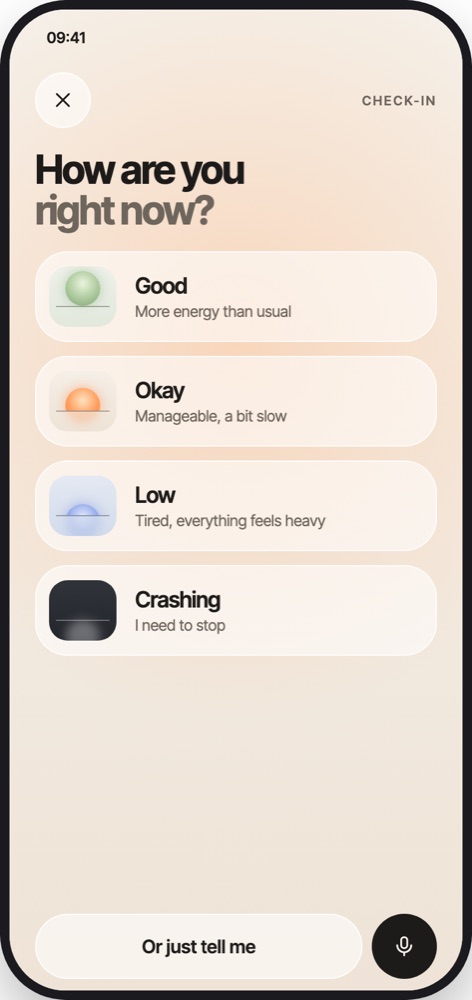 Check-in
How are you now?
Four states from good to crashing, plus optional signals like heavy legs. It takes seconds and needs no typing.
-
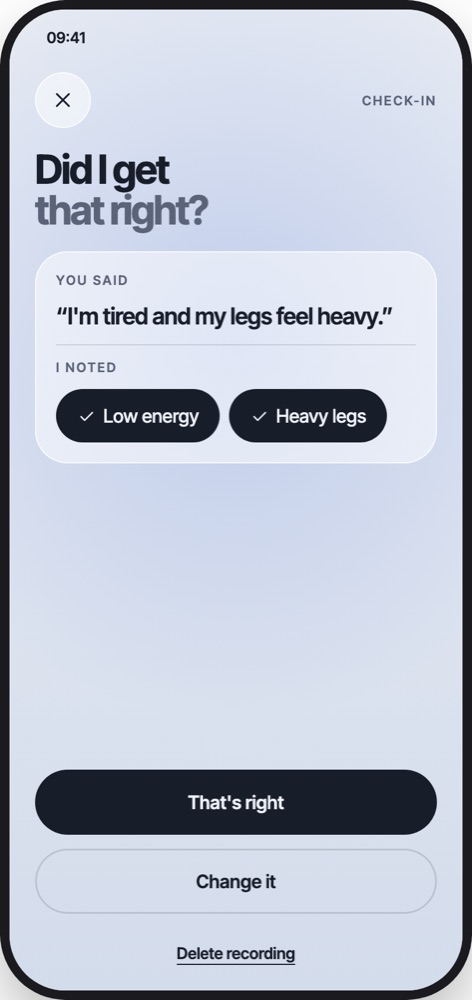 Voice
Voice check-in
With brain fog, talking can be easier than tapping. Solis turns what the person says into a state and signals, then asks if it got it right.
-
Today
Safe activity left
One number on the home screen shows how much you can still do today without risking a crash.
-
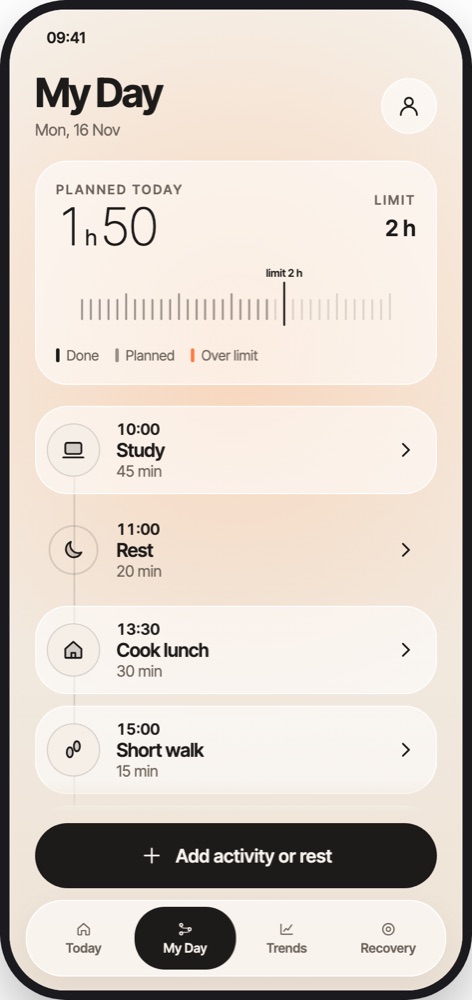 My Day
Daily limit
The day plan is shown against today's limit, so it is clear before the day starts if the plan is too much.
-
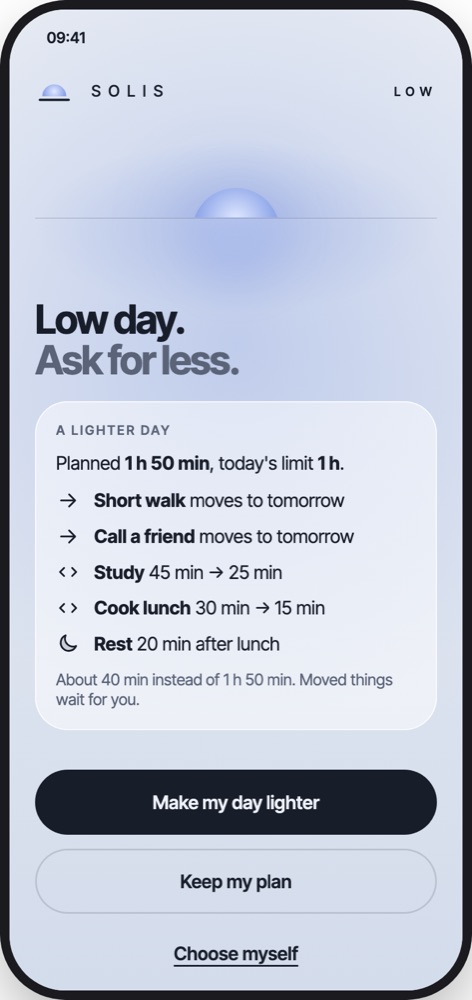 Lighter day
Solis suggests what to shorten or move to tomorrow. The person always has the final say.
-
Quiet mode
I need to stop
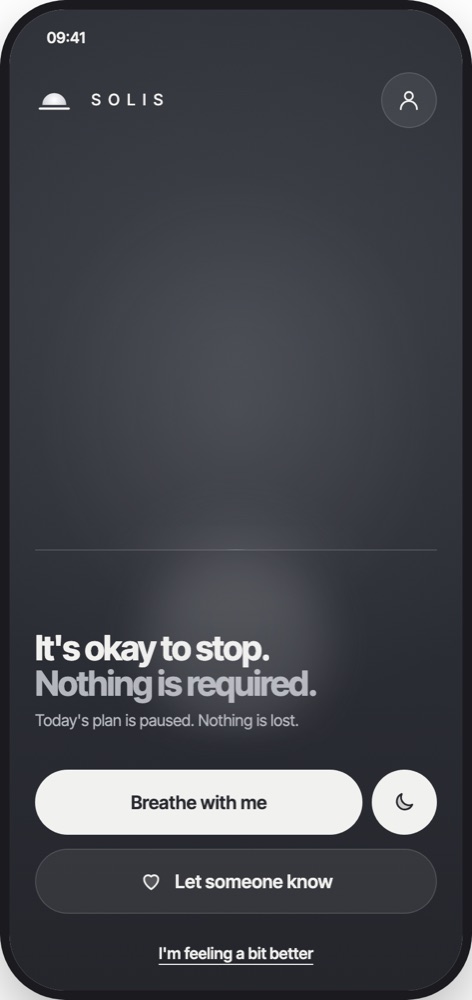
One tap pauses the plan and switches to a quiet screen. Nothing is lost.
-
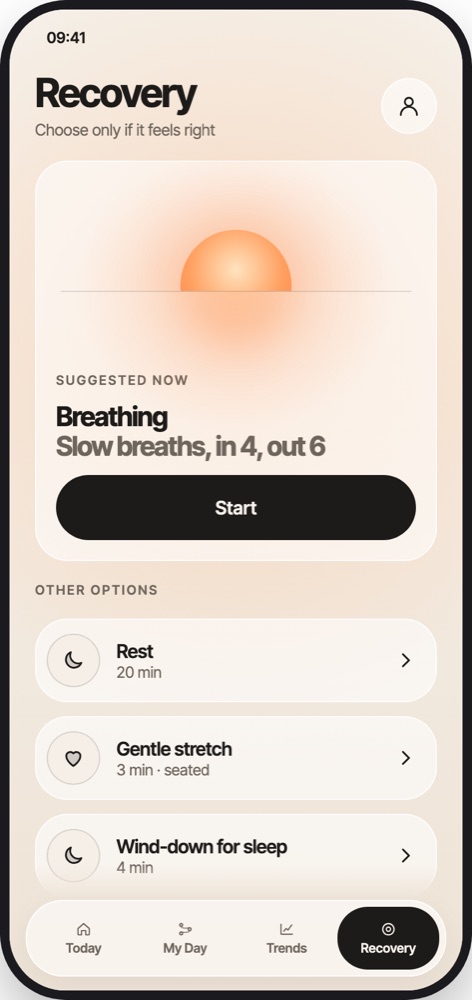 Recovery
Breathing, rest and gentle stretching are planned like other activities, so resting doesn't feel like failing.
-
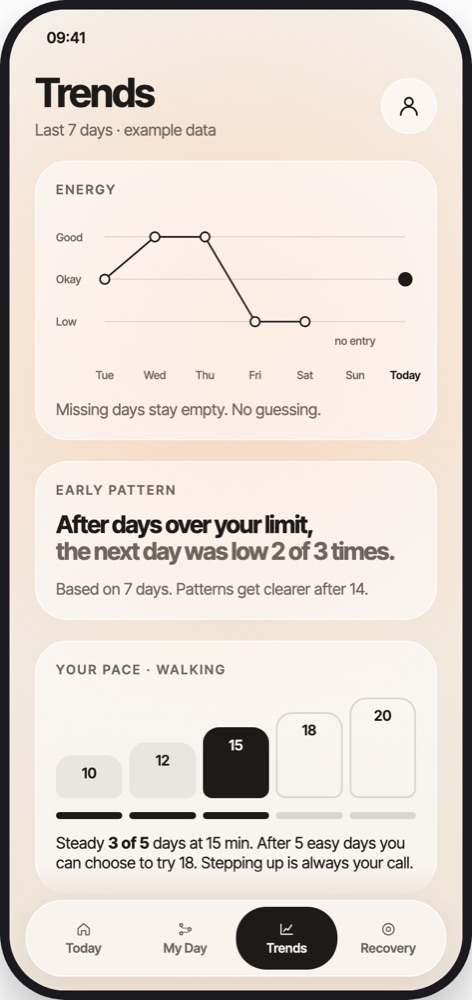 Trends
Energy over the last seven days, with patterns and early warning signs. There are no scores or streaks.
Look and feel
Four energy states
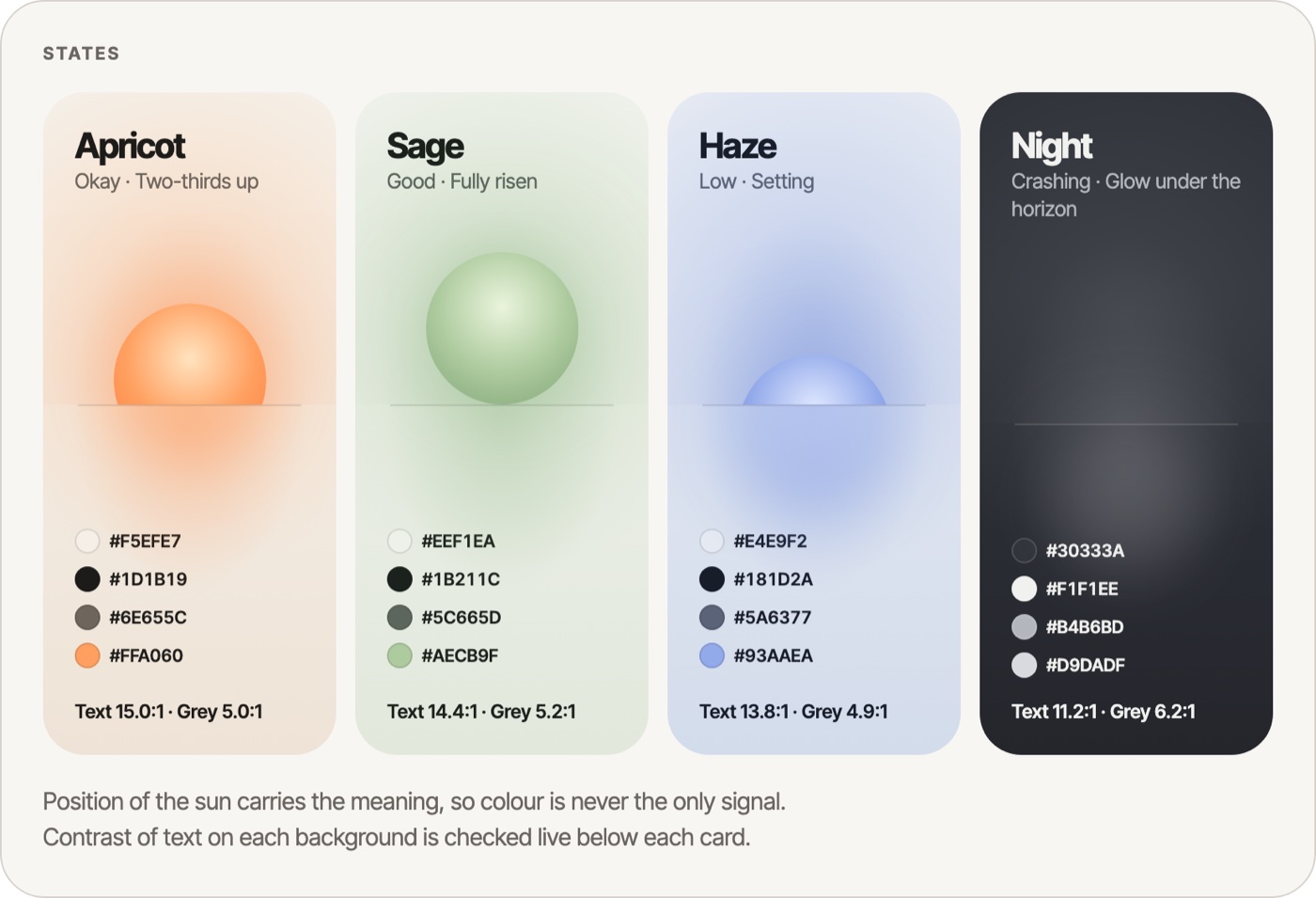
Busy screens wear out people with Long COVID, so the interface is calm, with soft colours and one thing in focus per screen.
Each energy state has its own colour: Sage for good, Apricot for okay, Haze for low and Night for crashing. The sun also sits at a different height in each state, so people who don't see colours well can still tell them apart.
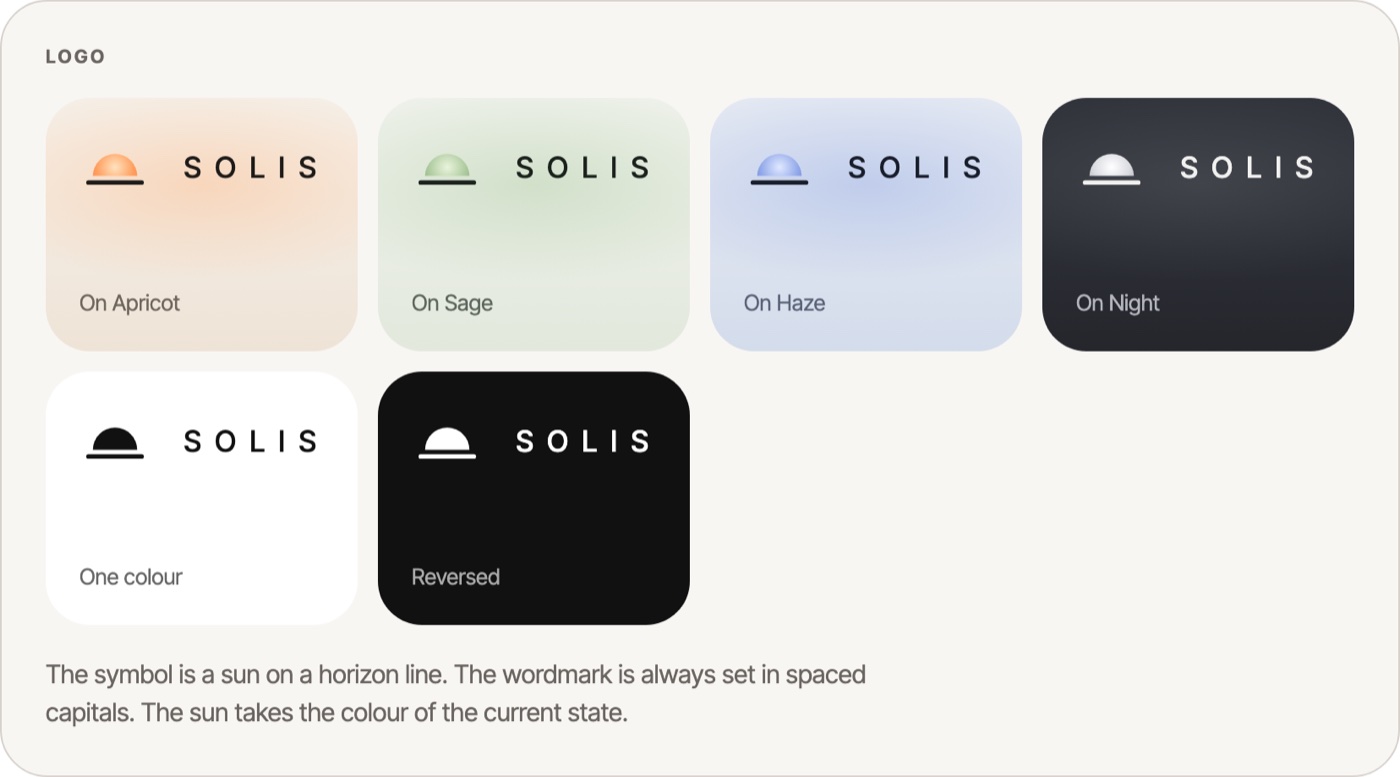
The logo is a sun on a horizon line with one loop in it, because recovery goes up and down. The font is Inter Tight, and the numbers are large and light, so they are easy to read when you are tired.
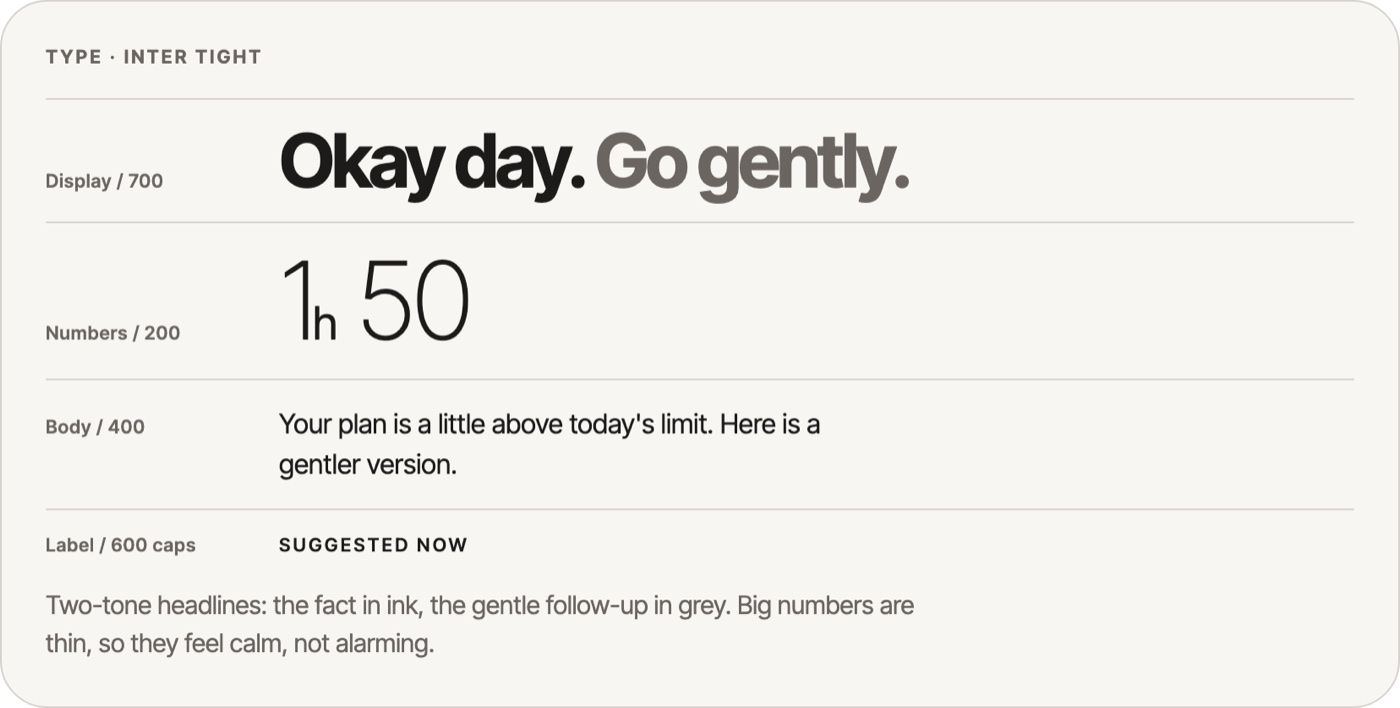
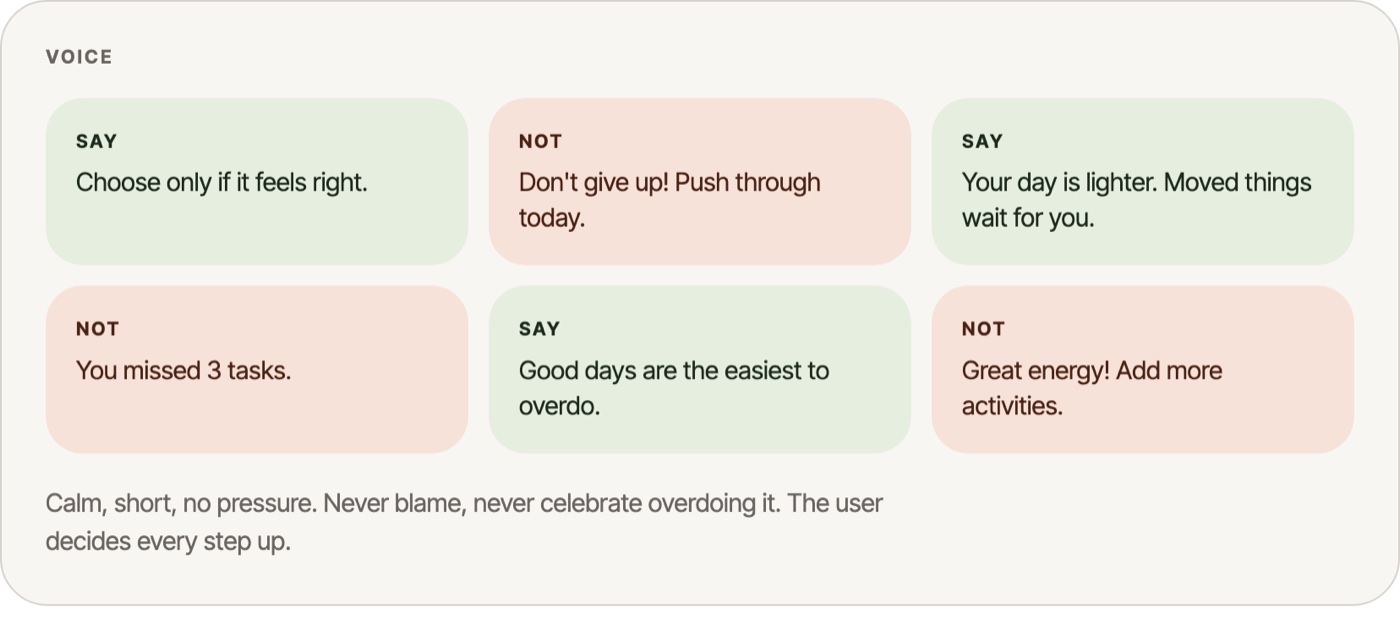
The tone of voice is short and calm. Solis does not blame people or push them to do more, because doing too much is what causes a crash.
Research
Research from three sources
I wanted to understand how Long COVID affects everyday life and what helps people recover.
Research questions
- Q1Which physical and cognitive symptoms are most common after COVID-19?
- Q2How do people experience these symptoms in daily activities, mood and social life?
- Q3What stops people from recovering: low energy, breathing problems, fear of overload?
- Q4Which rehabilitation methods do people use, such as breathing exercises, energy planning or physical therapy, and how well do they work?
Methods
- 01Desk research in medical articles and statistics gave the general picture of symptoms and recovery.
- 02For the netnography I read stories on Reddit, where people write openly. They show things that articles miss, and how people found their own way to recover.
- 03In the interviews I asked two people with Long COVID about their story, their symptoms, how they plan their energy, who supports them and what they would want from a tool.
Symptoms come in waves, and even a shower can lead to days of crash. Many people are told it is "just stress" and find their support in online communities. In all three sources, the thing that helped most was pacing in small, careful steps.
"People try to understand, but they can never imagine how bad it is. I discovered a new definition of being tired."
Interview participant
Synthesis
Eight clusters
Every finding went on a card, and I grouped the cards on an affinity diagram. That gave eight clusters.
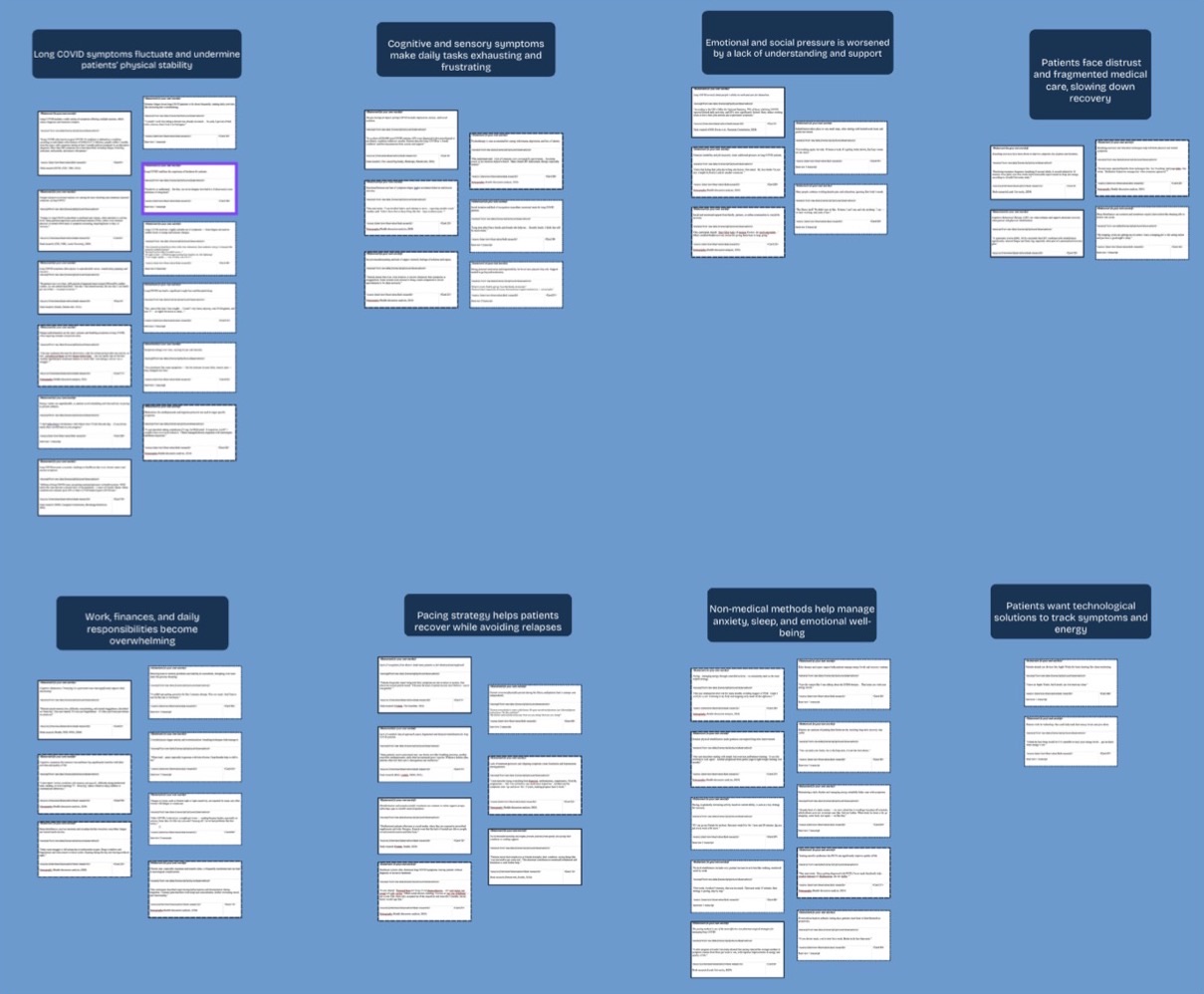
- 01Symptoms fluctuate and undermine physical stability.
- 02Cognitive and sensory symptoms make daily tasks exhausting.
- 03Pressure grows when people are not understood or supported.
- 04Distrust and fragmented medical care slow recovery down.
- 05Work, money and daily responsibilities become overwhelming.
- 06Pacing helps people recover while avoiding relapses.
- 07Non-medical methods help with anxiety, sleep and well-being.
- 08People want technology that tracks symptoms and energy.
Insights
From insight to feature
From the clusters came five insights, and each one became a feature in Solis.
- Insight 01
Energy runs out fast
A five-minute grocery run can mean hours of rest.
→ Safe activity left
- Insight 02
Pacing works, but it's hard
The hard part is not doing too much on a good day.
→ Aim to stop at, the limit ruler
- Insight 03
Thinking costs energy too
Brain fog makes planning and decisions tiring.
→ Make it lighter, check-in by voice
- Insight 04
Calm helps
Breathing and rest help with anxiety, sleep and fear of relapse.
→ Recovery, quiet mode
- Insight 05
Warn me before I crash
People want a signal when their energy is getting low.
→ Early signals, trends
Design direction
Two directions that Solis builds
The insights led to three possible directions. Solis builds the first two.
- 01The first is managing the day by energy, so people can decide which tasks come first today, even when thinking is hard.
- 02The second is supporting recovery with pacing: a plan that raises activity slowly, step by step, with breathing and rest built into it.
The third direction, a place for peer support among people with Long COVID, is not in the prototype yet.
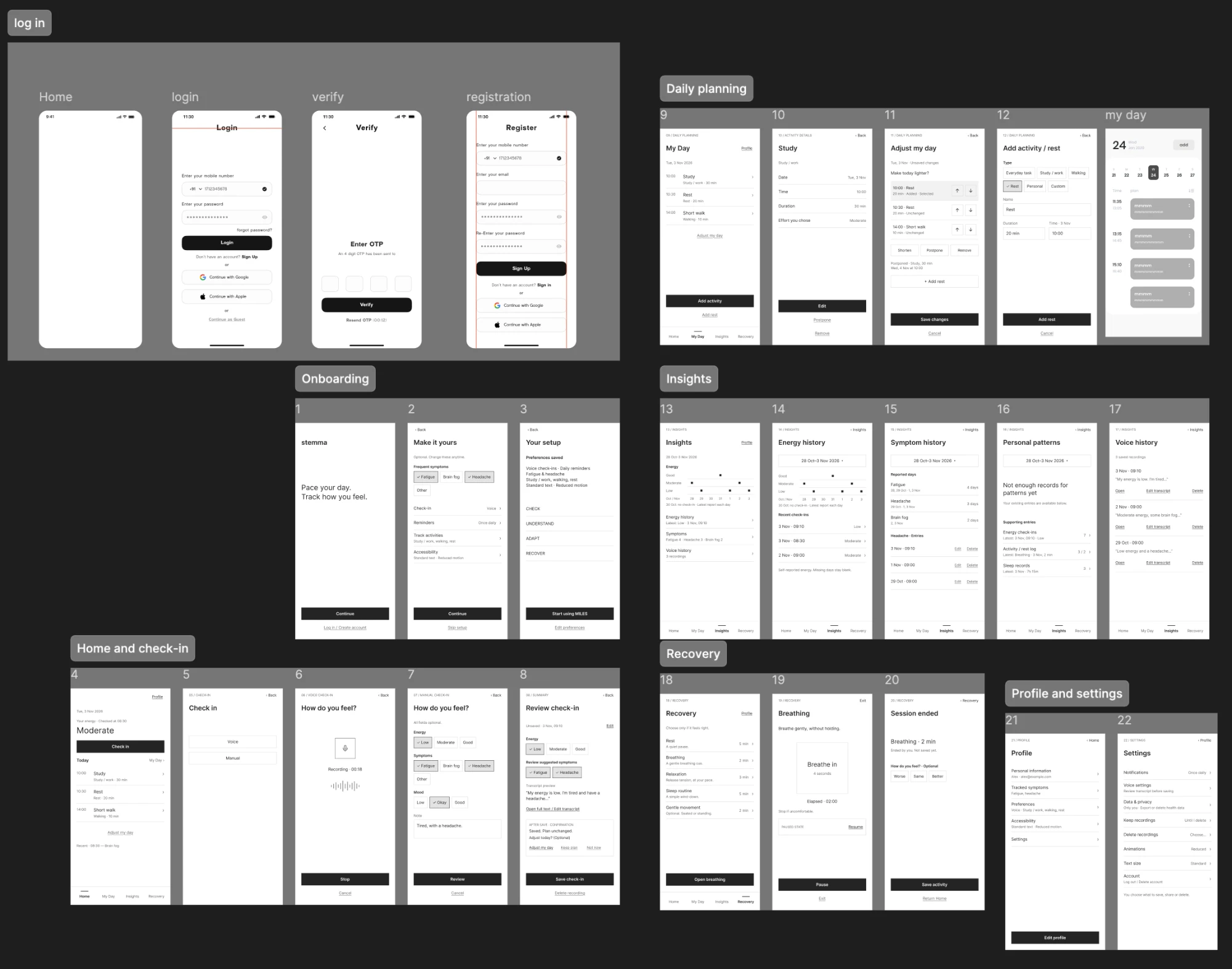
The first wireframes covered the whole app: login, onboarding, check-in, daily planning, insights, recovery, and profile and settings.
Persona & journey
A workday with Neo
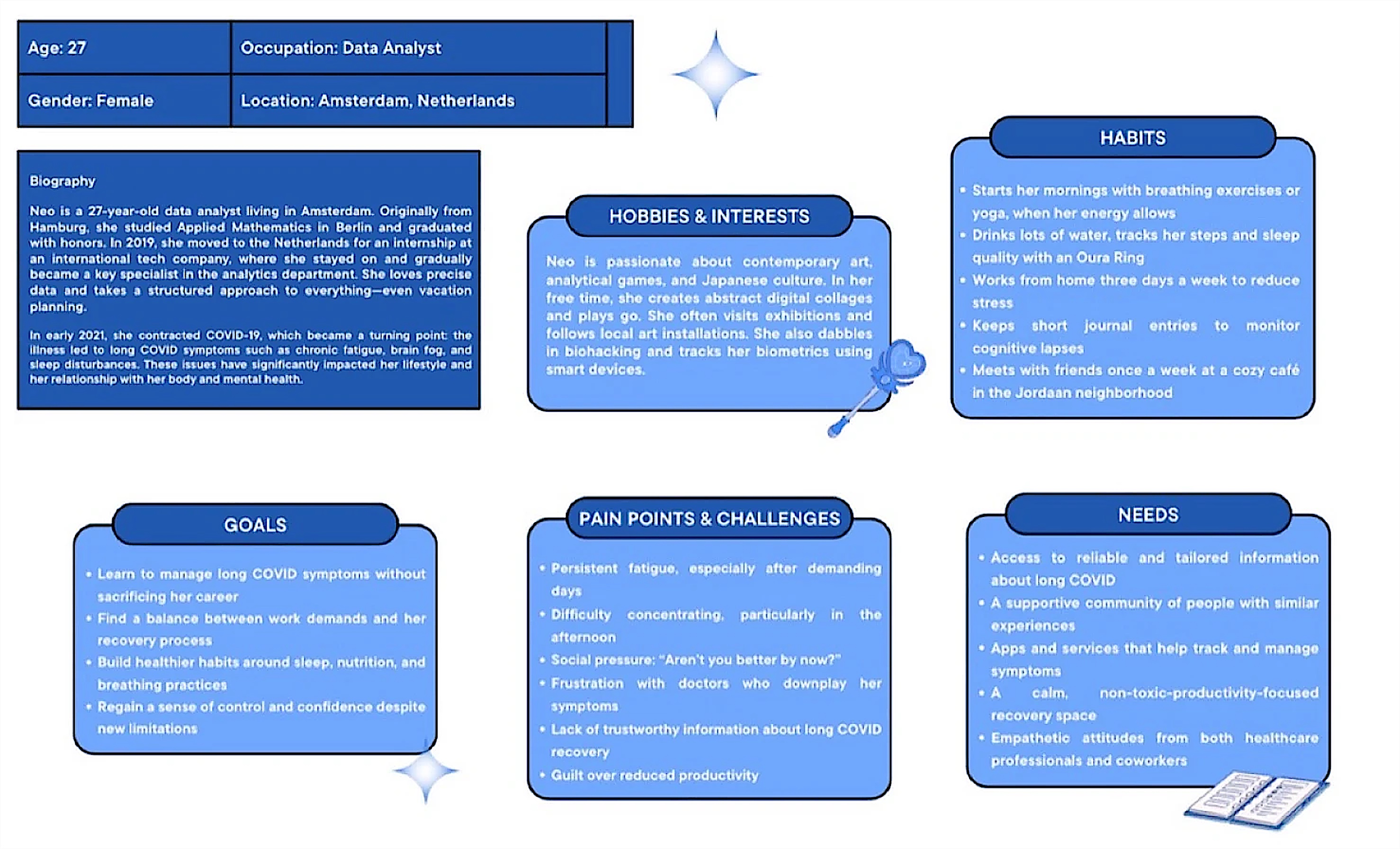
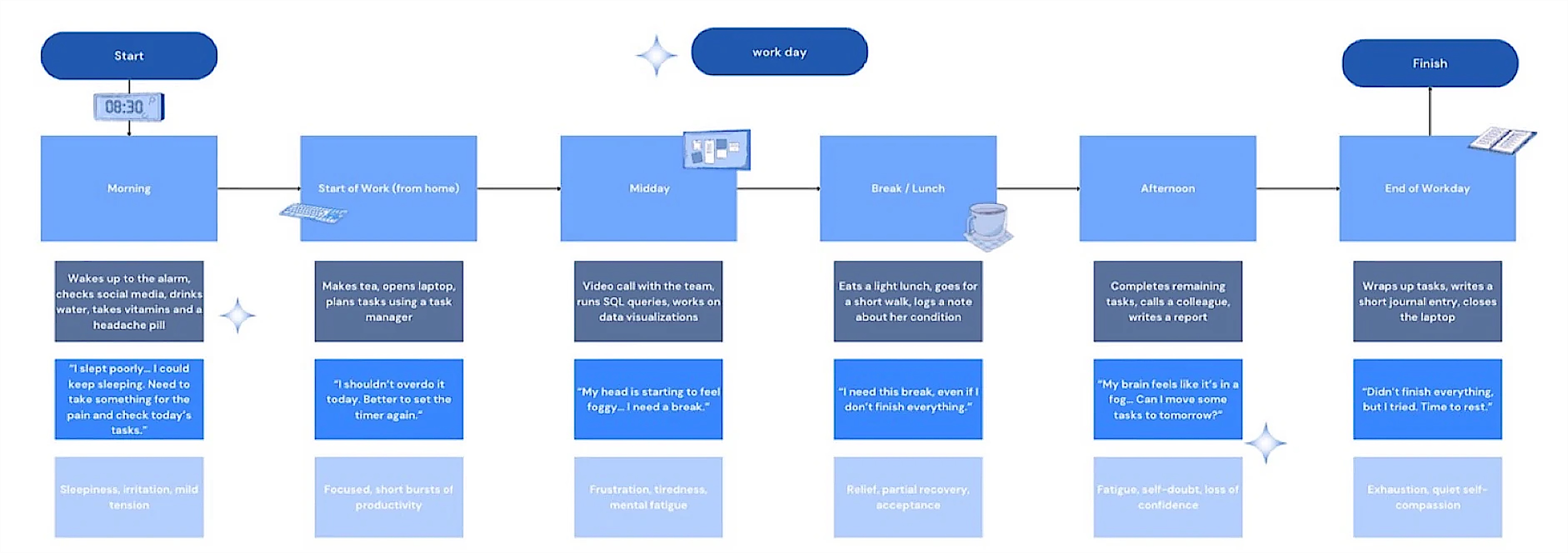
Neo is 27, works as a data analyst and has had Long COVID since 2021. Her workday shows where her energy runs out, and where Solis can help.
What I learned
What I can do now
- 01I combined desk research, stories from online communities and interviews, and each source answered a different question.
- 02I wrote an interview protocol and talked with two people with Long COVID about their days and the tools they use.
- 03I learned to turn notes into data cards, then into clusters and insights.
- 04Each feature in Solis comes from one finding. The limit ruler, for example, comes from how easy it is to overdo a good day.
- 05I designed a calm interface and a whole identity for it, from the four moods and the sun to the type and the tone of voice.
- 06I built a clickable HTML prototype that people can try, and recorded the main flows.